Starting a fitness journey can feel overwhelming, especially if you’re new to strength training. You might think you need an expensive gym membership, complicated machines, or a professional workout setup to build strength. But the truth is that a simple pair of dumbbells can help you get started right at home.
Dumbbell workouts are one of the most convenient ways to improve strength, build muscle, and develop better fitness habits. They allow you to train different muscle groups, adjust exercise difficulty, and create a workout routine that fits your lifestyle.
Whether you want to build stronger arms, improve your legs, or work toward better overall fitness, dumbbells offer plenty of exercise options.
In this complete beginner-friendly dumbbell workout guide, you’ll learn how to choose the right weights, perform basic exercises, create a workout routine, and make steady progress safely.
1. Understand the Benefits of Dumbbell Workouts
Dumbbells are a great choice for beginners because they’re simple, versatile, and easy to use.
Unlike complicated gym machines, dumbbells allow you to perform different exercises using a relatively small amount of equipment.
Here are some important benefits:
- Build muscle strength: Dumbbell exercises help strengthen different muscle groups.
- Improve balance: Many dumbbell movements require you to control both sides of your body.
- Support flexibility: Exercises can encourage controlled movement through a comfortable range of motion.
- Train at home: You don’t need a gym to perform effective strength exercises.
- Adjust workout difficulty: You can gradually increase resistance as your strength improves.
The biggest advantage is flexibility. You can create a full-body workout using just a few basic exercises.
2. Choose the Right Dumbbell Weight
Choosing the correct dumbbell weight is important when starting strength training.
If the weights are too heavy, maintaining proper exercise form can become difficult. On the other hand, weights that are too light may not provide enough resistance as you become stronger.
Start with a manageable weight that allows you to complete your exercises with good technique and controlled movements.
You should feel challenged toward the end of a set without losing control of the movement.
A few things to consider when choosing dumbbells:
- Your current fitness level.
- The exercises you plan to perform.
- Your strength and physical ability.
- Whether you have previous workout experience.
- Your ability to maintain proper form.
Adjustable dumbbells can be a practical option because you can change the resistance as your training improves.
Tip: Don’t choose weights just because they look impressive. Proper technique is more important than lifting heavy.
3. Start With Basic Dumbbell Exercises
As a beginner, focus on learning simple exercises that target major muscle groups.
You don’t need dozens of movements to build a useful workout routine. Start with a few basic exercises and practice them consistently.
Here are some beginner-friendly options:
Dumbbell Squats
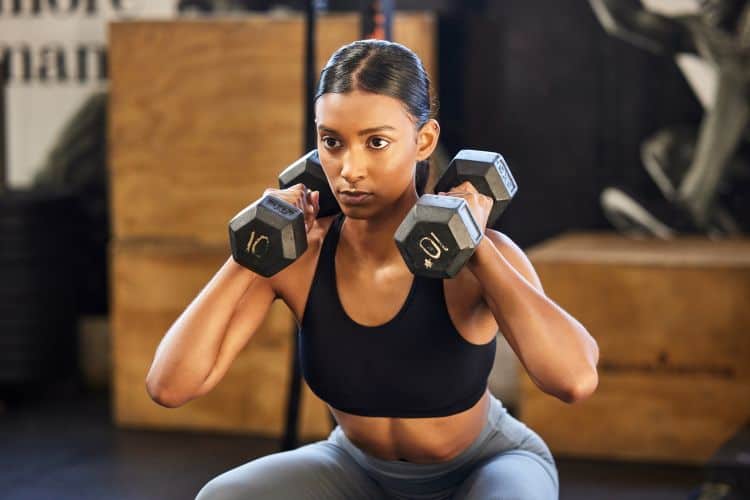
Dumbbell squats target your quadriceps, glutes, and other lower-body muscles. Hold a dumbbell in each hand or use one dumbbell in front of your chest. Lower yourself into a comfortable squat position and return to standing.
Dumbbell Shoulder Press
This exercise works your shoulders and triceps. Hold a dumbbell in each hand near shoulder level and press upward in a controlled movement. Lower the weights slowly.
Dumbbell Rows
Dumbbell rows help strengthen your upper back and arms. Support yourself with one hand on a stable bench or surface, hold a dumbbell in the other hand, and pull it toward your hip.
Dumbbell Bicep Curls
Hold a dumbbell in each hand with your palms facing forward. Bend your elbows to bring the weights toward your shoulders, then lower them slowly.
Dumbbell Romanian Deadlifts
This movement targets your hamstrings and glutes. Hold dumbbells in front of your thighs, push your hips backward, and lower the weights along your legs while keeping your back neutral.
Tip: Learn each movement without rushing. If an exercise causes pain or feels uncomfortable, stop and check your technique.
4. Warm Up Before Your Dumbbell Workout
Never skip your warm-up, especially when you’re new to strength training.
A short warm-up helps prepare your muscles and joints for exercise and allows your body to transition gradually into physical activity.
Spend around 5–10 minutes performing light movements such as:
- Marching in place.
- Arm circles.
- Shoulder rotations.
- Gentle bodyweight squats.
- Hip movements.
- Light walking.
Choose warm-up exercises that prepare the muscles you’ll be training.
Tip: Begin your workout with lighter weights or easier movements before progressing to your main exercises.
5. Follow a Simple Beginner Dumbbell Workout Plan
A beginner workout should be simple enough to follow consistently while covering the major muscle groups.
Here’s an example of a basic full-body dumbbell workout:
| Exercise | Sets | Repetitions |
|---|---|---|
| Dumbbell Squats | 2 | 10–12 |
| Dumbbell Rows | 2 | 10–12 |
| Dumbbell Shoulder Press | 2 | 8–10 |
| Dumbbell Bicep Curls | 2 | 10–12 |
| Dumbbell Romanian Deadlifts | 2 | 10–12 |
| Dumbbell Floor Press | 2 | 8–12 |
Choose weights that allow you to maintain good form throughout each set. Rest for around 60–90 seconds between sets, adjusting as needed.
You don’t have to complete every exercise perfectly on your first day. Focus on learning the movements and developing a comfortable routine.
6. Create a Weekly Dumbbell Workout Schedule
Consistency is more important than exercising intensely every day.
Beginners can start with two or three strength-training sessions per week, allowing recovery time between challenging workouts.
Here’s a simple weekly example:
| Day | Activity |
|---|---|
| Monday | Full-body dumbbell workout |
| Tuesday | Walking or light cardio |
| Wednesday | Rest or gentle stretching |
| Thursday | Full-body dumbbell workout |
| Friday | Light cardio |
| Saturday | Optional mobility or walking |
| Sunday | Rest and recovery |
As your fitness improves, you can gradually adjust your workout frequency and exercise selection.
Tip: Avoid training the same muscles intensely on consecutive days. Recovery is an important part of building strength.
7. Focus on Proper Form and Controlled Movements
One of the biggest mistakes beginners make is trying to lift heavier weights before learning proper technique.
Good form helps you target the intended muscles and reduces unnecessary strain on your body.
Keep these basic principles in mind:
- Move slowly and with control.
- Avoid swinging the dumbbells.
- Maintain a comfortable range of motion.
- Keep your core engaged when appropriate.
- Breathe naturally throughout each movement.
- Stop if you experience sharp or unusual pain.
If you’re unsure about an exercise, practice with lighter weights or seek guidance from a qualified fitness professional.
8. Gradually Increase Your Strength
As your body adapts to training, the same workout may begin to feel easier.
This is when progressive overload becomes important.
Progressive overload means gradually increasing the challenge placed on your muscles over time.
You can do this by:
- Increasing repetitions.
- Adding another set.
- Using slightly heavier dumbbells.
- Improving your movement control.
- Choosing a more challenging exercise variation.
You don’t need to increase the weight every week. Make changes only when you can complete your current exercises comfortably with proper form.
Tip: Keep a workout journal to track your weights, sets, and repetitions.
9. Support Your Workouts With Good Nutrition and Recovery
Strength training works best when combined with balanced nutrition and enough rest.
Your body needs protein to support muscle repair and maintenance. Include foods such as eggs, fish, chicken, milk, yogurt, beans, and lentils in your meals.
Also, eat a variety of fruits, vegetables, and whole grains to support your overall nutritional needs.
Don’t forget hydration and sleep. Most adults benefit from getting around 7–9 hours of sleep each night.
Tip: Avoid rushing into intense workouts when your body is exhausted. Give yourself enough recovery time between challenging sessions.
10. Stay Consistent and Be Patient
Building strength takes time, and your results may not appear immediately.
Instead of comparing your progress with other people, focus on your own improvements.
Maybe you can perform more repetitions than last month, use slightly heavier weights, or complete your workout with better technique. These are all signs of progress.
Set realistic goals, track your workouts, and celebrate small achievements.
Remember, a simple workout routine that you follow regularly is more valuable than a complicated plan you abandon after a few days.
Final Thoughts
Dumbbell workouts are an excellent way for beginners to start strength training, whether at home or in the gym.
With the right weights, basic exercises, proper technique, and a consistent schedule, you can gradually improve your strength and overall fitness.
Start with simple movements, focus on controlled repetitions, and allow your body enough time to recover.
You don’t need to rush or lift heavy weights to make progress. Take things one step at a time and build a routine that fits your lifestyle.
Remember, getting stronger isn’t about how much weight you lift on your first day. It’s about showing up consistently and improving a little over time.